Goals
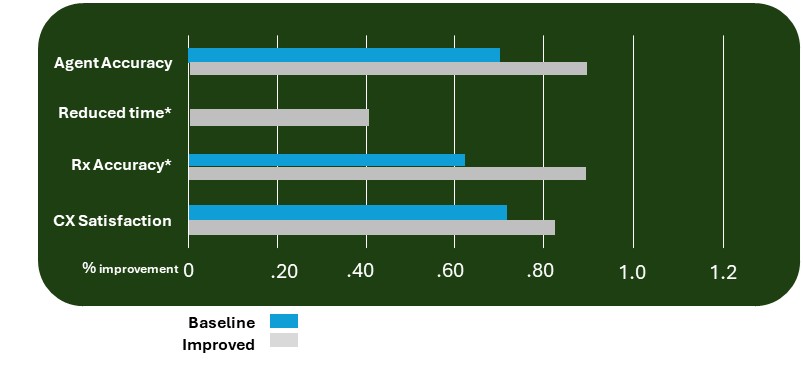
The goals of the automated search reviews of calls were to achieve a 20% reduction of mis-diagnosed plan coverage for complex health conditions, obtain greater than 30% reductions in incorrect Rx coverages, and reduce agent search/response time by more than five minutes per member request.
Business Value Achieved
Project Results
Project Overview
Using AI/Machine Learning, provide call center agents with the ability to automatically review existing complex medical, drug, and other ancillary coverages to determine member eligibility. The results provide an agent with a probability of coverage and direct agents to the supporting documentation without the need to find and retrieve this information across multiple backend systems, including both structured and unstructured data sources.
The Problem
Because many medical inquiries are complex, agents often struggle to determine whether a member's coverage is partial or complete. This challenge is compounded by frequently changing medical and prescription (Rx) benefits, as well as the wide range of plan options available. In addition to navigating multiple systems, agents must deliver accurate answers to support pre-authorizations and claim approvals, all while handling calls quickly to minimize wait times and maintain efficiency.
The Approach
To address these challenges, an AI-driven machine learning solution was introduced to quickly assess the probability of coverage and guide agents to the appropriate supporting documentation. The system performs advanced pattern analysis across both structured data — such as member benefit plans, medical policies, Rx formularies aligned to those plans, and current member eligibility — and other relevant sources. It then delivers a real-time "likelihood of coverage" score, indicating whether a service is fully covered, partially covered, or not covered, along with direct links to the supporting materials. This enables agents to move from minutes of manual searching to near-instant answers, allowing them to confidently respond to member inquiries with both speed and accuracy while providing clear supporting evidence.
Call Center Improved Quality
Project Insights
During the project, the following insights were gained:
- Large volumes of structured and unstructured data required a specialized solution to index and search through this information in sub-second times.
- ML required skilled human analysts to structure the data and "train" the models prior to getting satisfactory results due to the complexity of the data.
- Natural Language Processing added high value to the agents in allowing member queries to be translated to text and then normalized so the ML complex queries would be poised for more accurate search and retrieval. It also provided an ease-of-use factor for call center agents' use of the solution.
- Initial false positives/negatives were higher than anticipated. A dedicated effort of SMEs was required to review and select correct results and to increase search accuracy and improve analysis of results over time.
Summary of Findings
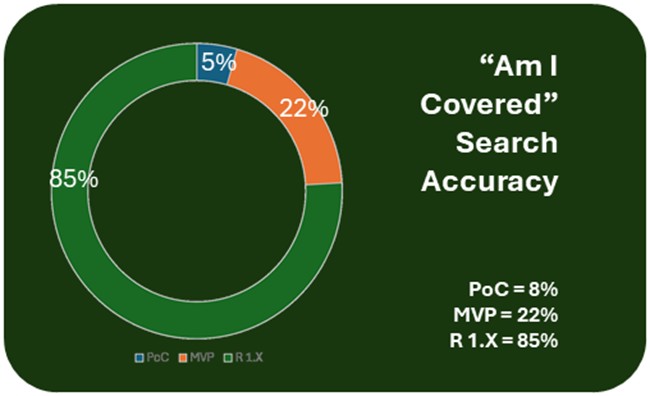
Agent response times improved by 40% for complex health coverage questions. Less complex queries reduced call wait times by 50%. Error rates by AI/ML reduced two-fold over time (18 months) as the AI/ML pattern recognition and learning increased in accuracy.