Goals
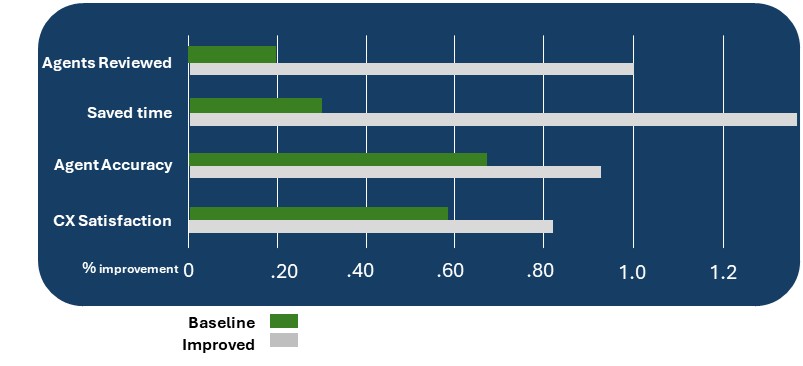
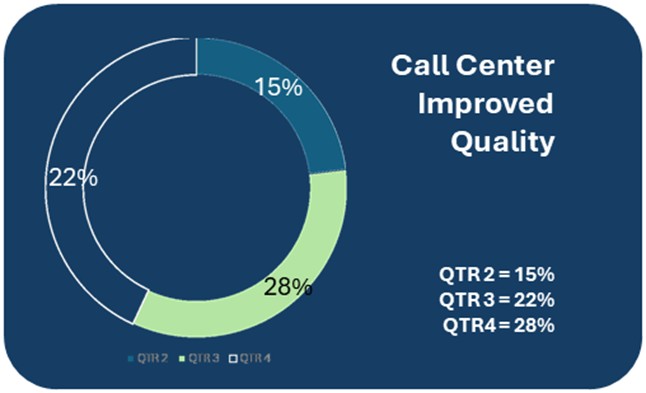
Using AI/Machine Learning and NLP, provide agent reviews of calls to achieve 100% review coverage of all agents per month. Reduce management call listening and review by over 50% in general agent review preparation time. Improve call quality by 15% Y1, 30% Y2, and 50% Y3.
Business Value Achieved
Project Results
Project Overview
Automate call center agent call analysis and provide summarized reporting to call center management identifying those call agents that required either additional training or call center supervisory guidance to achieve higher levels of customer satisfaction. The approach was to use AI/machine learning and natural language processing to convert recorded human speech to text with sentiment analysis.
The Problem
The client call center management team was required to review call center agent calls to determine accuracy of information, customer satisfaction, and level of customer irritation due to agent attitude or other frustrations. The call reviews required human listening and analysis of call center agents which, over the course of a week, averaged about 3 hours of supervisory listening and note-taking preparation prior to agent review. This resulted in a large degree of lost supervisory hands-on time, and a high degree of uncompleted agent reviews especially during peak season call loads.
The Approach
Utilized NLP and Google AI/NLP and machine learning algorithms to process large daily volumes of recorded call center agent voice interactions with customers. These recordings were processed from digital voice to text with sentiment analysis by agent and related customer calls. Using machine learning and pattern analysis, a custom set of AI/machine learning algorithms were developed to accurately identify those agents that fell outside an established baseline of customer satisfaction factors. These reports were ranked by customer satisfaction and other factors and sent to the associated call center agent supervisors for review and remediation.
Call Center Improved Quality
Project Insights
During the project, the following insights were gained:
- The large sizes of the stored daily recording volumes across the call centers were between 500-750 gigabytes. The large size of these recordings required a dedicated cloud bandwidth from the cloud vendor Google in order to send the information after 8 PM EST and processing time to convert the uploaded recording by 3AM. The reporting generated on the converted results took about three business working days on average to complete and update supervisor dashboards.
- Specialized filters and corrective actions were required on the converted text files. The NLP conversions were not exact due to garbled conversations or crosstalk interference between the agents and the customers. This required customized data quality algorithms and code to detect and attempt to correct errors on NLP conversions. However, the NLP accuracy was high — over 87% for conversations of 5 minutes or less, with considerable drop off for longer and more complex conversations involving health related insurance, drug coverages, etc.
- The ML algorithms and pattern matching exposed common agent incorrect responses not easily uncovered on a supervisor-by-supervisor basis. However, when analyzed in aggregate, there were common agent issues that led to improvement in training programs.
- Targeted training programs for existing agents and new agents resulted in increased customer satisfaction and reduced repeat customer calls for the same issues.
Summary of Findings
AI based NLP did not capture 100% of agent conversations correctly, but once data quality issues were resolved, ML identified new agent response patterns and enhanced the delivery of improved training and monitoring — making a positive impact on agents with poor CX scores.